

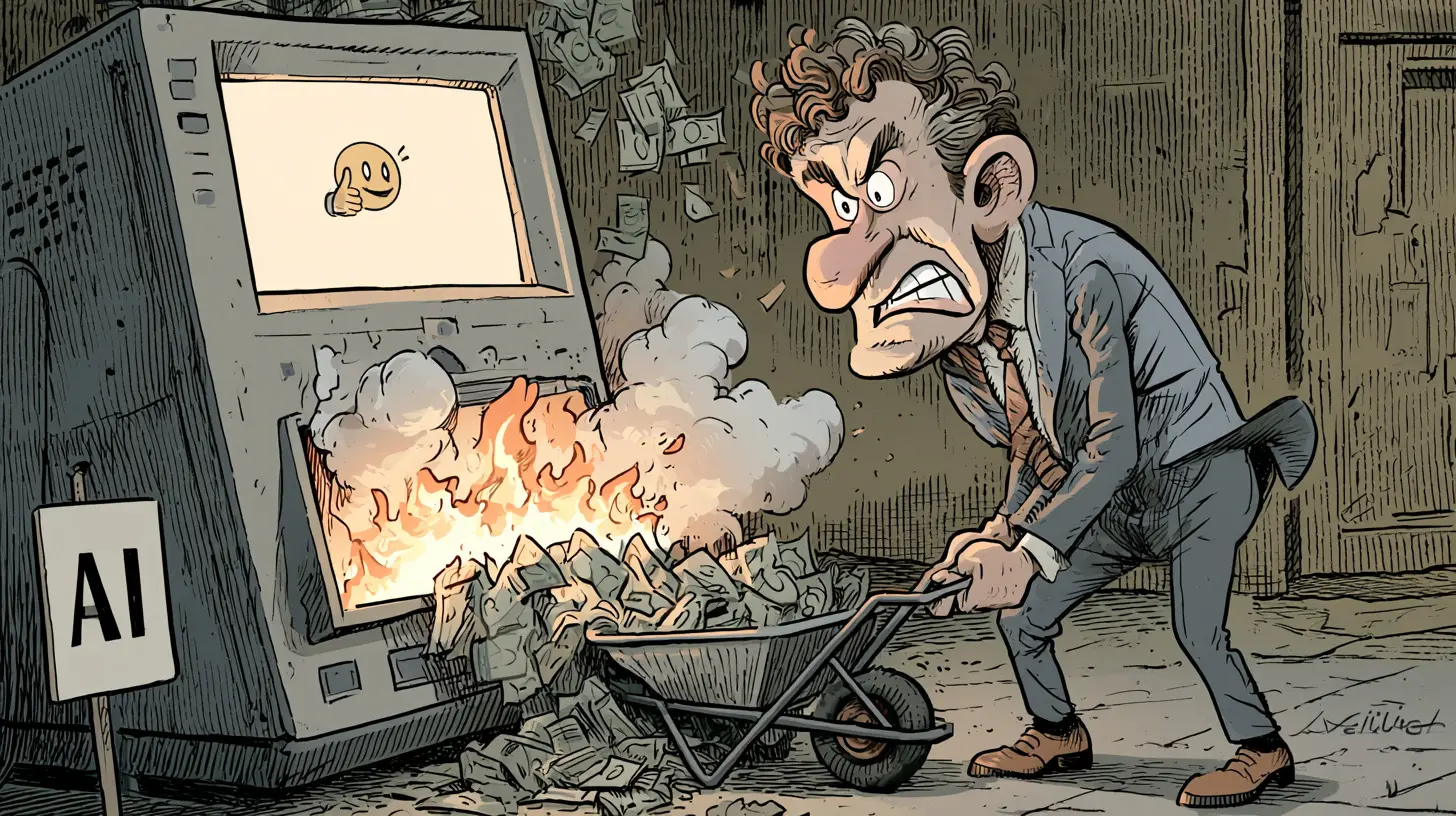
In a stunning revelation of the hidden costs of artificial intelligence, a company reportedly spent $500 million on Claude AI credits in a single month after failing to implement basic usage guardrails for employees. The incident, reported by Axios (paywalled), underscores a growing crisis in enterprise AI adoption: the promise of cost savings is giving way to massive budget overruns.
The unnamed company, likely a large enterprise, allowed its workforce unlimited access to Anthropic's Claude model without setting per-user limits or budget caps. Within weeks, the company consumed half a billion dollars' worth of tokens—a sum that would have been avoidable with standard administrative controls. This is not an isolated case. Uber recently disclosed that its engineers had exhausted the company's AI budget for the entire year of 2026. Other firms, including Costco, Delta Airlines, and IBM, have publicly expressed concerns about AI's return on investment, with some executives advocating for a return to human labor.
The Rise of Tokenmaxxing
The term 'tokenmaxxing' has emerged to describe the practice of burning through AI credits as rapidly as possible, often without regard for actual productivity gains. This behavior was common in the early stages of the AI boom, when companies encouraged employees to experiment with generative AI tools. However, as billing shifted from flat fees to usage-based models, the cost became unsustainable.
In response to mounting expenses, major technology providers are redesigning their pricing. Google and Anthropic have moved to stricter usage limits and consumption-based billing, causing frustration among non-enterprise users. Microsoft, which initially pushed its workforce to adopt AI tools like Copilot and Claude for 'vibe coding,' has now begun canceling Claude subscriptions and discouraging heavy usage. This reversal happened just six months after the company aggressively promoted AI adoption across departments.
Historical Context: The AI Cost Promise
When generative AI exploded in late 2022 and 2023, industry leaders predicted a revolution in efficiency. Companies were told that AI would automate routine tasks, reduce headcount, and lower operational costs. Early adopters like banks and retailers rushed to integrate AI, often without robust cost controls. The assumption was that AI would become cheaper over time due to economies of scale and model optimization.
Indeed, a recent Gartner report projects that inference costs for generative AI models will drop to one-tenth of 2025 levels by 2030. However, this forecast comes with a caveat: token usage is expected to grow 5 to 30 times over the same period. The net effect may still be higher spending, especially as enterprises deploy AI agents that operate autonomously and perform complex multi-step tasks. The cost of mistakes—such as the $500 million oversight—could escalate further as models become more integrated into core business processes.
Corporate Pushback and Workforce Implications
The backlash against uncontrolled AI spending is not limited to Fortune 500 companies. A growing number of small and medium businesses are reporting similar budget overruns. In response, some firms are instituting internal 'AI budgets' with strict per-employee caps. Others are requiring managers to approve large-scale AI projects, mirroring traditional IT procurement controls.
Uber's new COO, Andrew Macdonald, recently made headlines by publicly criticizing AI's productivity claims. He noted that despite heavy token usage among engineers, measurable gains in worker output were negligible. This sentiment has resonated across the internet, leading to a broader reassessment of AI's value proposition. Even within Big Tech, there is skepticism. Amazon, Meta, and Microsoft have continued job cuts even as they invest billions in AI infrastructure, raising questions about whether automation is truly substituting or merely augmenting human work.
The $500 million incident has become a cautionary tale in corporate boardrooms. It highlights a fundamental flaw in the deployment of generative AI: treating it like a free resource. Unlike traditional software, where licenses are fixed costs, AI consumption can scale unpredictably. A single employee running hundreds of queries per hour can generate unexpected charges quickly. Without governance, the bill can spiral out of control.
Lessons for Enterprises
To avoid similar disasters, experts recommend implementing multi-layered controls. First, set per-user daily or weekly token limits. Second, establish dashboards to monitor usage in real time. Third, enforce spending alerts at the departmental level. Fourth, conduct regular audits to identify unusual patterns. Cloud providers like AWS and Azure now offer these capabilities, but many organizations ignore them until after a financial incident occurs.
There is also a cultural component. The early AI hype cycle encouraged a 'move fast and break things' mentality. That mindset, while beneficial for innovation, is incompatible with cost discipline. Companies must shift toward a balanced approach that values efficiency over tokenmaxxing. This includes training employees to use AI judiciously and rewarding resource-conscious behavior.
Another emerging trend is the consolidation of AI procurement. Rather than letting individual teams sign up for separate services, centralized IT departments are negotiating enterprise agreements with volume discounts and strict usage caps. This approach gives organizations greater leverage over pricing and helps prevent unauthorized spending sprees.
Despite these measures, the broader AI industry faces an uncertain future. The economic model that fueled the boom—venture capital subsidizing low prices to win market share—is showing signs of strain. As investors demand profitability, AI providers will need to raise prices or find new ways to reduce costs. This could lead to a shakeout, with smaller companies unable to compete on price while larger ones lock customers into long-term contracts.
The $500 million incident may be a harbinger of what is to come. It demonstrates that the true cost of AI is not just its development but its deployment. For many organizations, the challenge is no longer whether to adopt AI, but how to afford it without breaking the bank. The era of freewheeling AI experimentation is drawing to a close, replaced by a more sober calculation of return on investment.
As token usage continues to multiply—driven by increasingly complex multi-agent systems—the need for guardrails becomes ever more critical. Enterprises that fail to learn from this costly mistake will likely face similar budget shocks in the future. The AI dream may not be ending, but it is certainly entering a phase of financial realism.
Source: Android Authority News