

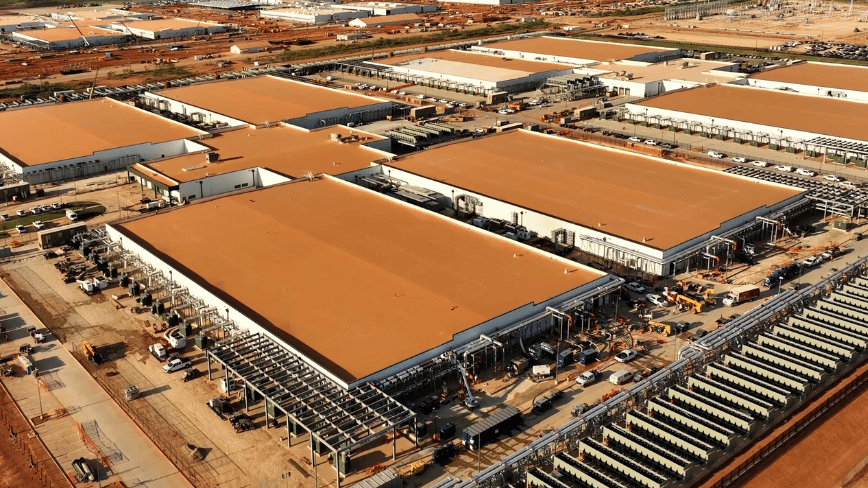
In short: Iran’s Islamic Revolutionary Guard Corps has released a video threatening “complete and utter annihilation” of OpenAI’s $30bn Stargate AI campus in Abu Dhabi, singling out the facility by name for the first time and warning it will strike if the US proceeds with threatened attacks on Iranian civilian infrastructure.
A senior officer in Iran’s Islamic Revolutionary Guard Corps has issued a stark warning regarding OpenAI’s flagship AI data center situated in Abu Dhabi. The threat came in a video that begins with a blurred satellite view of the expansive desert site and transitions to clear night-vision footage showcasing the sprawling Stargate campus. The overlaid text ominously states: “Nothing stays hidden to our sight, though hidden by Google.”
This video, released on April 3, 2026, by Brigadier General Ebrahim Zolfaghari of the IRGC, signifies a notable escalation in Iran’s stance. Just days prior, the IRGC had named 18 US technology firms, including Apple, Microsoft, Nvidia, and Tesla, as legitimate military targets without specifying any particular facility. The Stargate video marks the first instance where the IRGC has explicitly identified a specific installation as a target for potential destruction.
Zolfaghari indicated that the IRGC would execute the attack if the United States acted on President Donald Trump’s threats to bomb Iranian power plants and desalination facilities. While the threat is conditional rather than immediate, it follows a month of increasing military tensions, with the US-Israel joint campaign initiated on February 28, 2026, leading to Iranian retaliatory strikes on Gulf energy infrastructure, military sites, and notably, commercial data centers.
What is Stargate UAE?
Stargate UAE is the international flagship of the $500 billion Stargate joint venture between OpenAI, SoftBank, Oracle, and the Abu Dhabi sovereign investment vehicle MGX. It is being constructed and financed by UAE AI firm G42 over an expanse of approximately 19 square kilometers of desert south of Abu Dhabi, with operations jointly led by OpenAI and Oracle. SoftBank’s involvement is partially backed by a $40 billion bridge loan arranged with major financial institutions in late 2025.
The facility's first phase, comprising a 200-megawatt compute cluster powered by Nvidia Grace Blackwell GB300 systems, is projected to be operational by the end of 2026. Upon full completion, the campus aims to achieve a total capacity of 1 gigawatt, with an estimated construction cost exceeding $30 billion. It is said to house up to 500,000 Nvidia GPUs, although this figure remains unverified. If completed as planned, Stargate UAE would become the largest concentration of AI computing power outside the United States.
Various companies are contributing to the infrastructure: Cisco provides zero-trust networking, Oracle manages cloud operations, and Nvidia supplies the primary chips. The UAE government, through G42, oversees construction and land interests, while OpenAI is responsible for model training and inference workloads.
A conflict that has already reached the server room
The threat to Stargate is no longer hypothetical. On March 1, 2026, Iranian Shahed drones targeted two Amazon Web Services data centers in the UAE and damaged a third in Bahrain, resulting in significant service disruptions across the Gulf. This unprecedented attack marked the first recorded instance of a state intentionally targeting commercial data centers as part of an active military operation, adding credibility to the current threat against Stargate.
Additionally, Iran claimed responsibility for striking an Oracle data center in Dubai on April 2, which Dubai's media office disputed, leaving the actual situation of that facility unclear. The AWS strikes underscored a dangerous precedent, making the threat to Stargate a serious concern rather than mere geopolitical bluster.
The stakes for global AI infrastructure
The timing of this threat poses significant concerns for the industry. Analysts predict that hyperscaler capital expenditures could surpass $600 billion in 2026, with a substantial portion allocated for AI infrastructure development. The Gulf region was anticipated to be the fastest-growing data center market globally, driven by large-scale campus developments in the UAE and Saudi Arabia.
This situation has heightened concerns among insurers and institutional lenders, who are reevaluating risk models for Middle Eastern infrastructure amidst escalating geopolitical tensions. A successful attack on Stargate or a prolonged threat could drastically alter future AI compute site selections, potentially favoring regions like Northern Europe, India, and Southeast Asia.
One analyst pointed out the dilemma starkly, questioning the viability of insuring a $20 billion facility in the Middle East vulnerable to low-cost drone strikes. The ongoing conflict also brings to light the intertwined nature of cybersecurity and AI infrastructure as strategic priorities. It has been characterized as the first major conflict significantly influenced by AI-assisted targeting, with advanced technologies shaping military decisions.
OpenAI has yet to publicly address the threats, navigating a complex landscape where its relationship with Microsoft is under scrutiny due to Microsoft's development of its AI models. A halt or destruction of the Abu Dhabi facility would severely impact OpenAI’s planned expansion of its computational capabilities outside the US.
As of April 6, 2026, Iran has not acted on its specific threats, while ceasefire negotiations remain at an impasse. Iran has dismissed a US proposal for a temporary ceasefire, and Trump's threats towards Iranian civilian infrastructure continue unabated. The $30 billion campus, still under construction, stands at a critical crossroads of two conflicts: one involving kinetic military actions across the Gulf, and the other centered on the control of future AI computational resources. The outcome of these tensions may significantly shape the landscape of AI development in the coming decade.
Source: TNW | Amazon News