

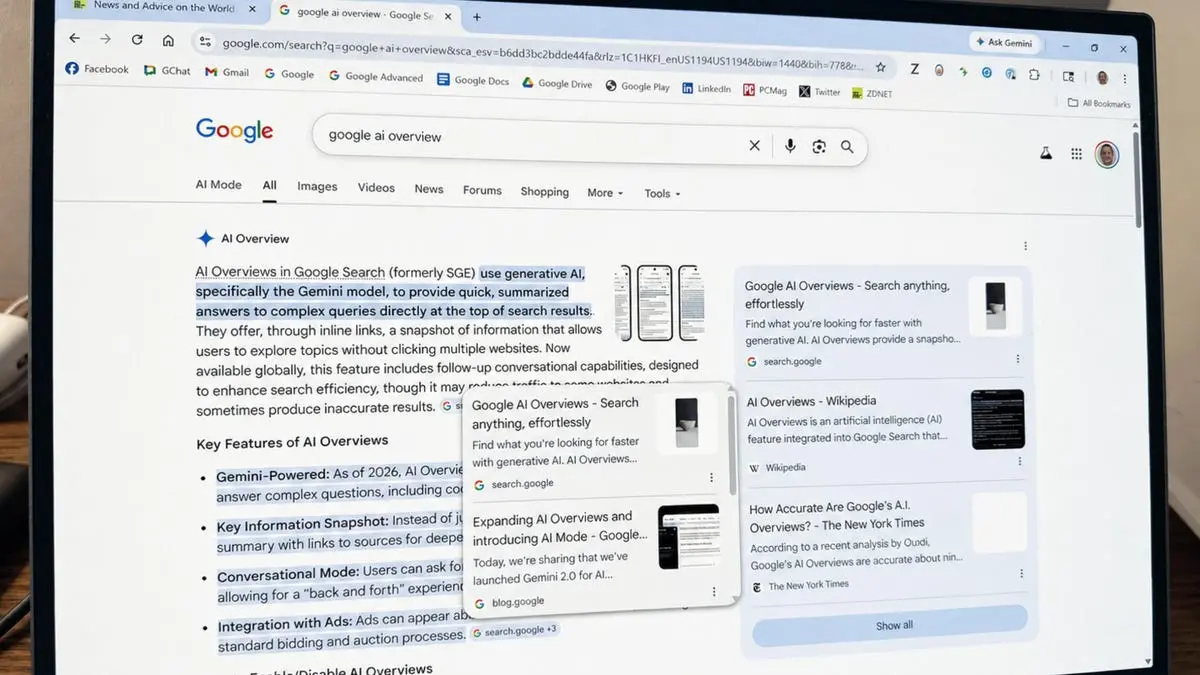
Google has announced a significant update to its AI Overviews, introducing five new features that aim to make search results more comprehensive and user-friendly. The changes focus on integrating human perspectives, improving source transparency, and enhancing the overall browsing experience. This update comes as Google continues to refine its generative AI search capabilities, building on the initial rollout of AI Overviews and addressing user feedback about the need for more reliable and accessible information.
Background: The Evolution of AI Overviews
Launched as a key part of Google's Search Generative Experience, AI Overviews use large language models to provide concise summaries at the top of search results. These summaries are designed to answer user queries directly, drawing from a variety of web sources. However, early adoption revealed limitations: the overviews often lacked depth and failed to adequately cite sources, leading to concerns about accuracy and transparency. With this latest update, Google aims to bridge the gap between automated summaries and the rich, diverse content available on the web.
The five new features are the result of extensive testing and user research. Google has focused on three core principles: surfacing original voices, improving link visibility, and helping users discover trustworthy information. Each feature addresses a specific pain point, from the inability to see community opinions to the difficulty of accessing preferred news sources.
1. Expert Advice from Other People
One of the most anticipated additions is the Expert Advice section. When users search for topics that benefit from personal experience—such as pet care, photography techniques, or travel tips—the AI Overview will now feature brief remarks from individuals on discussion forums, social media, and other online communities. Each remark includes the name of the person or forum and a link to the full discussion, allowing users to dive deeper into the conversation.
For example, a user searching for "best camera settings for northern lights" might see advice from a photography forum detailing specific exposure times and ISO settings. This feature not only enriches the search result but also encourages engagement with niche communities. Google emphasizes that these remarks are carefully curated to ensure relevance and quality, drawing from authoritative platforms like Reddit, Quora, and specialized forums. The addition of human voices helps counterbalance the often generic nature of AI-generated summaries, providing real-world insights that machines cannot replicate.
2. Access to News Subscriptions
Many users rely on specific news sources for reliable information, but accessing full articles from within AI Overviews has historically been cumbersome. The new update addresses this by highlighting links to users' subscribed news outlets directly in AI Mode and AI Overviews. When a search query matches content from a subscribed source, a small label or icon indicates that the full story is available without a paywall.
Google reports that early tests showed a significant increase in click-through rates for subscription-labeled links. Publishers can opt in via the Subscription Linking page, ensuring their content reaches engaged readers. This feature benefits both users, who get seamless access to preferred journalism, and publishers, who can monetize their content through subscriptions. For instance, a ZDNET subscriber searching for "latest tech trends" would see direct links to ZDNET articles within the overview, bypassing generic summaries.
3. Source Links Next to Relevant Text
One of the most common criticisms of AI Overviews has been the lack of clear attribution. Users frequently see a summary but struggle to identify which parts came from which source. The third feature solves this by placing clickable links directly next to the relevant text within the summary. This inline linking allows users to verify information instantly and explore original content without scrolling to the bottom of the page.
For example, a query about "planning a bike trip along the California coast" might yield a bullet-point summary. Under the update, each point could be accompanied by a link: one to a Pacific Coast bike touring guide for terrain details, another to a blog post about training for daily mileage. This granular linking not only builds trust but also reduces the risk of misinformation, as users can independently confirm claims. Google notes that this technique, called "query fan-out," helps the AI dig deeper into the web to find the most relevant and authoritative sources for each snippet.
4. Additional Source Suggestions
Beyond the immediate sources used to generate the overview, Google is now providing a new section with recommendations for further reading. Appearing below the AI summary, this section contains links to articles, case studies, or analyses that explore different angles of the same topic. This feature is particularly useful for complex subjects where users may want to compare perspectives or dive into specialized subtopics.
Consider a search about "urban green space initiatives." Below the main overview, the AI might suggest a case study on Seoul's stream restoration project or a report on the High Line park in New York City. These suggestions are algorithmically generated, based on relevance and diversity of viewpoints. By offering this curated list, Google aims to turn the AI Overview into a springboard for deeper exploration, rather than a final destination.
5. Link Previews on Hover
The final feature addresses user hesitancy about clicking unknown links. When a user hovers over a URL within the AI Overview, a small preview pop-up displays the name or title of the target site, along with a brief description. This allows users to assess the credibility and relevance of the link before committing to a click. The preview helps reduce the uncertainty that often accompanies navigating to an unfamiliar domain.
Google designed this feature based on feedback that users often skip links in AI Overviews because they don't know where they lead. Early implementations show that link previews increase click-through rates, particularly for less well-known but authoritative sources. The feature is part of a broader effort to make the web as transparent and user-friendly as possible, even when the content is generated by AI.
Technical Enhancements and Future Directions
Behind these user-facing features are significant technical improvements. Google has refined its ranking algorithms to prioritize original voices and authoritative sources, while also expanding the diversity of websites indexed for AI summaries. The query fan-out technique mentioned earlier allows the system to retrieve more targeted content from the long tail of the web, ensuring that even niche topics are covered with relevant data.
Additionally, Google has invested in natural language processing to better understand user intent and context. For instance, the Expert Advice feature relies on sentiment analysis and topic modeling to identify the most helpful community contributions. Similarly, the inline linking mechanism uses entity recognition to match specific claims with their originating sources, reducing the risk of misattribution.
The company has also emphasized that these features are subject to continuous improvement. User feedback will play a crucial role in refining the accuracy of source suggestions, the relevance of expert advice, and the overall user experience. Google plans to roll out the updates gradually across supported regions, starting with English-language queries in the United States.
Implications for Publishers and Content Creators
For publishers, these changes represent both an opportunity and a challenge. On the one hand, more transparent linking and subscription integration can drive qualified traffic to their sites. The ability to have links placed directly next to relevant text increases the likelihood that users will click through. On the other hand, the inclusion of community-driven advice from forums and social media may dilute the prominence of traditional journalistic sources. Publishers will need to ensure their content remains authoritative and well-structured to be chosen by Google's algorithms.
Google has provided guidelines for publishers seeking to optimize their content for AI Overviews, including the use of structured data, clear headlines, and well-organized sections. The Subscription Linking page offers a straightforward way for outlets to participate, and the company has committed to sharing data on click-through performance with participating publishers.
The Role of Human Expertise in AI Search
Perhaps the most notable shift in this update is the explicit acknowledgment of human expertise. By surfacing advice from real people in forums and social media, Google is blending machine-generated summaries with grassroots knowledge. This hybrid approach recognizes that certain types of questions—especially those involving personal experience, subjective opinions, or localized knowledge—are best answered by humans. The Expert Advice feature, in particular, signals that Google sees value in the messy, nuanced conversations that happen across the web, rather than relying solely on polished articles.
However, this also raises questions about quality control. Not all forum posts are accurate or helpful, and Google's algorithms must carefully filter for relevance and reliability. The company has not disclosed the exact criteria used to select community contributions, but it likely involves a combination of user ratings, domain authority, and contextual relevance. Over time, these mechanisms will be refined to prevent the spread of misinformation while preserving the authenticity of human voices.
User Experience and Accessibility
From a user standpoint, the new features are designed to be intuitive and unobtrusive. The Expert Advice section appears only when the query is likely to benefit from personal insights, and the link previews appear only on hover. Google has also ensured that the features work seamlessly on mobile devices, where most searches now occur. The inline source links are tappable, and the previews load quickly without disrupting the page.
Accessibility considerations have been incorporated as well. The previews are readable by screen readers, and the subscription labels use clear icons that are distinguishable by color and shape. Google's focus on inclusivity ensures that the benefits of these updates are available to as many users as possible, regardless of device or ability.
Source: ZDNET News