

The Asus ROG Zephyrus G14 has long been a favorite among laptop enthusiasts seeking a blend of portability, power, and versatility. Since its introduction in 2020, it has consistently balanced gaming performance with a sleek, compact design that rivals productivity-focused machines. The 2026 model continues this tradition, upgrading to Intel's new Panther Lake processors and adding a full-size SD card slot—a feature that many photographers and content creators have long craved. Yet, with prices starting at $3,450 and the reviewed configuration reaching $3,600, the value proposition that originally defined the line has shifted dramatically. This in-depth analysis examines whether the latest Zephyrus G14 still delivers on its promise of being the one laptop for everything.
Design and Display
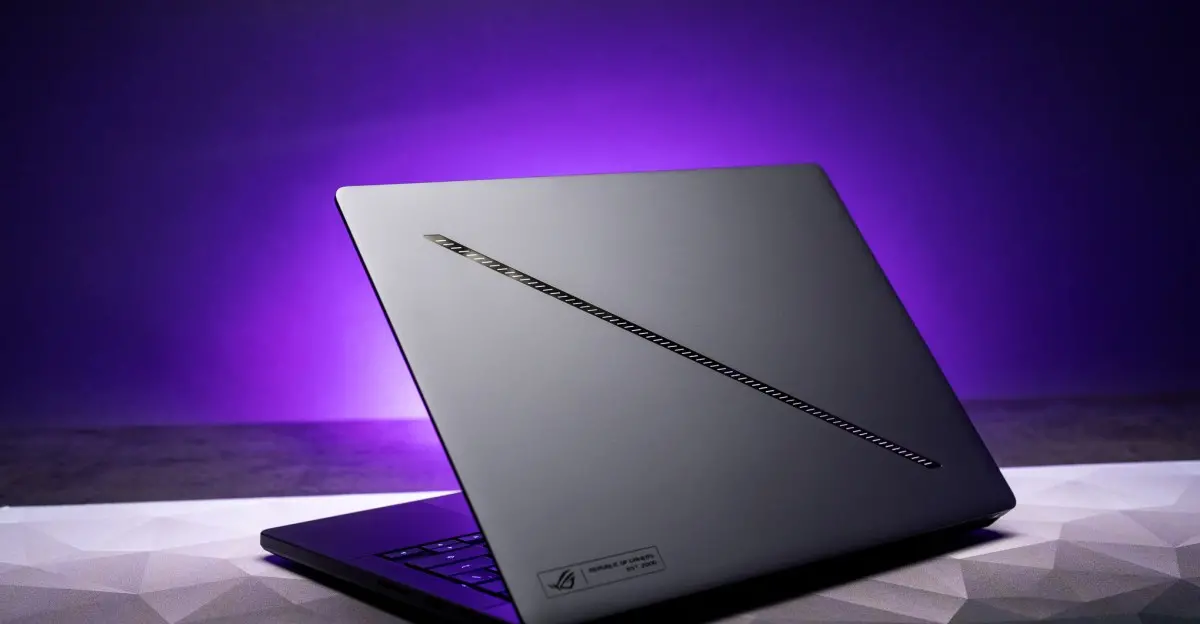
The 2026 G14 retains the chassis redesign introduced in 2024, offering a slim profile that measures just 0.63 to 0.72 inches thick and weighs 3.48 pounds—comparable to the 14-inch MacBook Pro. Build quality remains excellent, with a magnesium-aluminum alloy construction that feels both premium and durable. The lid features an updated slash lighting system with more LED segments, providing customizable animations that add a subtle gaming aesthetic without being garish. The bottom panel now uses circular ventilation holes instead of rectangular slots, slightly improving airflow and reducing dust accumulation.
The display is a standout feature: a 14-inch 2880 x 1800 OLED panel running at 120Hz. It achieves 500 nits sustained brightness in SDR and peaks at 1,100 nits in HDR, making it vibrant and usable even in bright environments. Color accuracy is excellent, covering wide gamuts suitable for photo and video editing. The matte finish helps reduce glare, a welcome improvement over glossy alternatives. While some professionals might prefer a higher refresh rate for competitive gaming, the 120Hz panel offers a smooth experience in most titles without sacrificing battery efficiency.
Port selection has been updated to include a full-size SD card slot—a rare and welcome addition on a thin-and-light gaming laptop. Other ports include two USB-C ports (one Thunderbolt 4, one USB 3.2 Gen 2), two USB-A 3.2 Gen 2, HDMI 2.1, and a 3.5mm audio jack. The proprietary power connector remains, but both USB-C ports support Power Delivery, offering flexible charging options. The webcam is 1080p with facial recognition, though its low-light performance is mediocre—a common compromise in this category.
Keyboard and Trackpad
The keyboard continues to be one of the best in its class, offering deep key travel (1.7mm) and a satisfying tactile response. The layout is spacious, with full-size arrow keys and a dedicated row for function keys. The mechanical trackpad is large and responsive, though it does not provide clickable feedback in all four corners—a minor disappointment compared to some competitors. Still, most users will rely on a mouse for gaming, and the trackpad remains reliable for everyday tasks.
The six-speaker system, tuned with dual force-canceling woofers and tweeters, delivers impressive audio quality for a 14-inch chassis. Sound is rich and full, with clear mids and adequate bass, easily competing with the MacBook Pro's speakers. The spatial audio and wide stereo separation enhance both gaming immersion and media consumption.
Performance
Under the hood, the 2026 model features Intel's Core Ultra 9 386H processor, a 16-core (6P + 8E + 2LP) chip built on the Panther Lake architecture. Paired with an Nvidia GeForce RTX 5070 Ti Laptop GPU (5,888 CUDA cores, 130W TGP), the G14 delivers strong performance across productivity and gaming workloads. In CPU-intensive tasks like photo editing in Adobe Lightroom Classic, the laptop feels snappy, with quick preview generation and smooth adjustments even when processing 50-megapixel RAW files. Video editing in Premiere Pro is equally capable, though 4K exports take longer than a similarly priced MacBook Pro with an M5 Max chip.
Gaming performance is impressive for such a portable device. In Battlefield 6, at native 2880x1800 resolution with High settings, average frame rates hover between 65 and 70 fps without DLSS. Helldivers 2, which lacks DLSS support, runs at 80-90 fps at similar settings. Marathon, with DLSS set to Quality, maintains around 70 fps. The laptop remains thermally controlled under load: the keyboard deck stays comfortably cool, though the bottom panel gets warm. The Armoury Crate software offers Performance and Turbo modes, with Turbo boosting GPU clocks by 50MHz and dynamic boost up to 20W, adding roughly 10 fps to many titles at the cost of louder fan noise.
Synthetic benchmarks bear out the real-world experience. The G14 achieves a Geekbench 6 single-core score of 2,909 and multi-core score of 17,145. In Cinebench 2026, it scores 517 single-core and 4,645 multi-core. GPU performance in 3DMark Time Spy reaches 14,941, a strong showing for a thin-and-light system. However, its SSD read speeds (6,154 MB/s) and write speeds (5,372 MB/s) are about 12% slower than the previous generation, a minor regression that rarely affects real-world tasks.
Battery Life
One of the most significant improvements with the Intel Panther Lake platform is power efficiency. In our battery rundown test (continuous web browsing and video playback at 150 nits), the 2026 G14 lasted over 17 hours—more than double the 8.5 hours of the last-gen AMD model. Real-world usage confirms this: with mixed workloads (multiple Chrome tabs, Slack, music streaming, and occasional photo editing), the laptop easily exceeded 10 hours at 80% screen brightness. Even with an hour of GPU-intensive tasks, total battery life drops to around five to six hours, which is still competitive for a gaming laptop. The 73Wh battery recharges quickly via the included 200W adapter or USB-C PD.
Price and Value
The elephant in the room is cost. The 2026 Intel-based G14 starts at $3,450 for a configuration with RTX 5070 Ti, 16GB RAM, and 1TB SSD. The reviewed unit, with 32GB RAM, costs $3,600. That is roughly $1,000 more than a nearly identical last-gen model with an AMD Ryzen AI 9 HX 370 and the same GPU. While the new model offers better battery life, a brighter OLED panel, and the SD card slot, the premium is steep. For context, a base 14-inch MacBook Pro with M5 chip and 16GB RAM costs $1,949, and a loaded M5 Max model reaches $3,600—and outperforms the G14 in CPU-bound tasks with superior battery life.
The value equation is further complicated by the fact that last year's AMD version remains available for under $2,000 on sale. That model still delivers excellent performance, a nearly identical design, and only slightly worse battery life and port selection. For most users, it represents a much smarter buy unless the absolute best battery life or the SD card slot is non-negotiable. Asus also competes with its own Strix Scar 16, which at $3,300 offers a larger 240Hz Mini LED screen, higher frame rates, but much less portability.
Alternatives
If you're willing to spend $3,600, you could instead purchase a MacBook Pro 14 with M5 Pro (32GB RAM, 1TB SSD) for around $2,999 and a gaming console like a PlayStation 5 Pro or a Steam Deck for the remainder. This combination would provide significantly better CPU performance and battery life for productivity, plus a dedicated gaming device. For those who need a single machine, the Razer Blade 16 offers similar performance with a larger display but at an even higher starting price. The Framework Laptop 16, while less powerful, provides modularity and repairability that the G14 lacks.
The 2026 Asus ROG Zephyrus G14 is an exceptionally well-rounded laptop that excels in every area: display, keyboard, speakers, battery life, and gaming performance. It feels like the device that reviewer Antonio Di Benedetto—or any creative professional who also games—has been waiting for. Yet the soaring price, driven partly by global memory shortages and the shift to Intel chips, diminishes its appeal. The G14 was once celebrated for offering premium features at a mid-range price; now it's a luxury item that asks you to pay a premium for incremental improvements. The core question remains: does the convenience of having one device for everything justify the cost? For those with the budget, the answer is yes. For everyone else, the previous generation remains a more pragmatic choice.
Source: The Verge News